
How Indian Fashion is shaping the Western World
By Ishani Raj
Indian Fashion has always held a unique place: a vibrant blend of colour, craftsmanship, fabric, and embroidery. For generations, Indian artisans have perfected techniques such as zardozi embroidery, mirror work, block printing, and handloom weaving, creating textiles that are as rich in history as well as beauty. From saris to lehengas and salwar kameez, every piece highlights the artistry and attention to detail that define Indian fashion. Over the past decade, the Western world has increasingly embraced the essence of Indian fashion. What was once seen as “ethnic wear” is now influencing international couture and everyday style.
“Today, the embroidery you see at Paris Couture Week - whether it’s Chanel, Dior or McQueen - is often the work of Indian artisans” - Sujata Assomull, Fashion Journalist
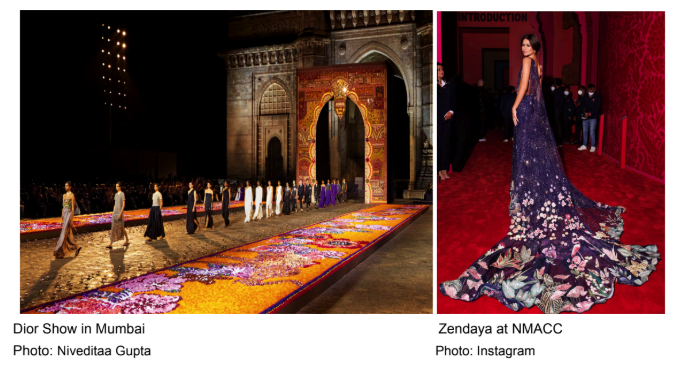
This influence is visible in many recent events. Dior held its pre-fall 2023 fashion show at the Gateway of India. The show celebrated Indian craftsmanship through a collection created in collaboration with the Mumbai-based atelier, Chanakya, featuring 99 ensembles inspired by Indian silhouettes. Designers like Sabyasachi Mukherjee made their mark internationally at the Met Gala red carpet by designing a couture sari with an exaggerated train. At the NMACC event in Mumbai, Zendaya stunned in a hand-embroidered Rahul Mishra sari-inspired ensemble, while the Kardashians wore pieces by Manish Malhotra and Tarun Tahiliani at the Ambani wedding, blending Hollywood glamour with Indian craftsmanship.

Alia Bhatt for Gucci, Photo: Getty Images
Outside the world of runways, global brand ambassadors such as Alia Bhatt for Gucci, Ananya Panday for Chanel, Deepika Padukone for Louis Vuitton, and Priyanka Chopra for Bvlgari are bringing Indian representation to international luxury houses. And it’s not just celebrities. As a university student in the UK, I often see brown girls on campus styling jhumkas with their Western outfits or proudly wearing saris for graduation.
Acknowledgment of Indian fashion’s global influence has undoubtedly grown, although there is more ground to cover. For instance, when Gucci referred to Alia Bhatt’s saree as a “gown”, it sparked conversations about cultural awareness and credit. Similarly, Prada’s “Kolhapuri chappal” controversy, where the brand released sandals inspired by traditional Indian footwear without acknowledgment led to backlash over cultural appropriation. Prada later recognised the design’s Indian roots and collaborated with local artisans in Kolhapur, marking a small but meaningful step toward responsible representation.
In conclusion, Indian fashion has evolved into a powerful global influence: a movement that celebrates craftsmanship, culture, and authenticity. Its impact is now seen not only on international runways but also in the daily choices of people who proudly carry a piece of their heritage wherever they go. The world isn’t just noticing Indian fashion anymore; it’s embracing it.