
The Damn Fine Costume Design of ‘Twin Peaks’
By Kitty Volino
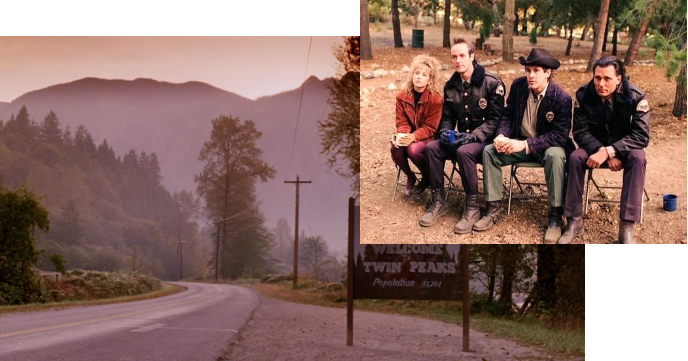
Image Credit: Twin Peaks Blog
Twin Peaks was one of the most groundbreaking television shows of the 1990s. In a pre-streaming age, it united audiences around the world longing to answer the infamous question, ‘Who killed Laura Palmer?”. The show both parodied and paid homage to soaps and detective dramas of the time. David Lynch’s passion for both the absurd, and 1950s America brought the town of Twin Peaks to life. Yet while the search for homecoming queen Laura’s killer looms large, cracks in the idyllic small town begin to show, exposing its dark underbelly.
These ideas were conveyed by costume designers Sara Markowitz and Patricia Norris. Norris designed the costumes for the show’s pilot, while Markowitz took over for the twenty-nine-episode run. Their collaborative efforts combined classic elements of the 1950s with the jarring patterns of the 1980s, giving the characters a distinctly Lynchian look.
Most characters overtly wear uniforms. The members of the Sherriff’s department and waitresses at the Double R Diner all have designated outfits, which the audience rarely sees them out of. Even characters who do not have a uniformed job have a set style they rarely deviate from. The locals of Twin Peaks are defined by their costumes, and each nuance marks both their social status and class, adding to the idea of uniformity in a small town.
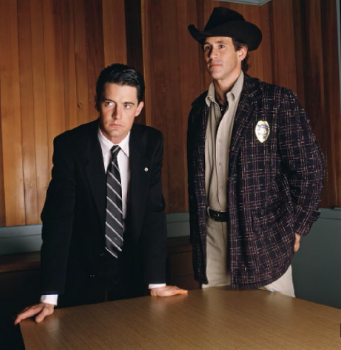
Image Credit: iMDB
Agent Cooper (Kyle MacLachlan) is first introduced in his signature FBI black suit, with slicked back hair and starched shirt. When he meets Sherriff Truman (Michael Ontkean), the difference between the two is immediately noticeable. Cooper’s shirt is done up to the top button, whereas Truman’s is not. Equally, Cooper opts for an oversized trench coat while Truman favours plaid. Overall, Cooper is a hallmark of neatness, while Truman embodies the earthen style of Twin Peaks. These small intricacies all mark that he is an ‘outsider’.
Plaid is arguably the most prominent pattern in the show. It’s not only realistic for the setting but represents the morality of the town. Characters such as Pete (Jack Nance) or Ed (Everett McGill) are looked on as reliable and trustworthy, and as such are rarely out of it. Yet characters with dubious morality, such as Ben (Richard Beymer), or Leyland Palmer (Ray Wise), hardly wear any at all.
Meanwhile, women’s fashion also plays a very prominent role, particularly accessories. Laura’s gold heart-shaped locket is one of the first clues discovered, and Donna swipes a pair of her sunglasses in an attempt to emulate her best friend. Most famously, Laura’s (Sheryl Lee) velvet Black Lodge outfit is accessorised with a large brooch of a snake. The choice of animal here is ambiguous. It may reflect a Victorian symbol of eternity, or the ancient symbol ouroboros, representing life, death, and rebirth – all key notions of the Black Lodge.
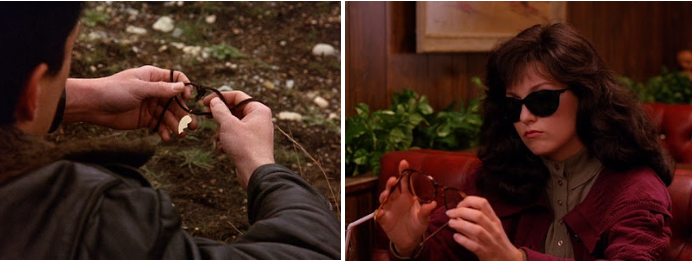
Image Credit: Twin Peaks Props
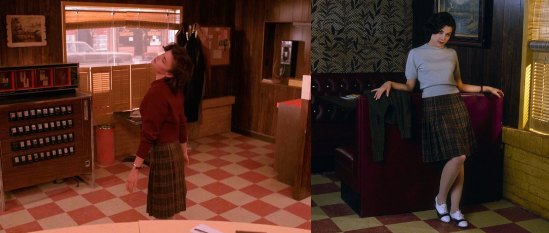
Image Credit: Twin Peaks Blog
Perhaps most iconic are Audrey Horne’s (Sherilyn Fenn) outfits. Audrey typically opts for a 1950s style midi skirt, with a matching jumper. In her famous dance scene in episode one, Audrey seamlessly blends into the Double R Diner décor, in a tartan skirt and coordinated maroon jumper.
Equally as significant are Audrey’s saddle shoes which she wears throughout the series. The shoes again nod to styles of the 1950s, in a classic monochrome design. In the pilot, they are drawn to the audience’s attention when Audrey swaps them out at her high school for a pair of red kitten heels. The colours of the different shoes evoke the Black lodge – the iconic white and black flooring paired with red velvet curtains. What initially seems a simple teen rebellion is perhaps prophetic of what’s to come in the solving of Laura’s case.
The enduring impact of the fashion of Twin Peaks can still be seen in fashion campaigns over 25 years later. In 2013, ‘Elle’ created a Twin Peaks themed fashion shoot, combining the monochrome mystique of the Black Lodge, with the style its iconic cast. While the mystery of Laura’s killer has long been solved (no spoilers), the influence Norris’ and Markowitz’s iconic designs have had in both pop culture and the fashion industry has proven to be long-lasting.