
A Brief History of Halloween in Scotland
By Kitty Volino
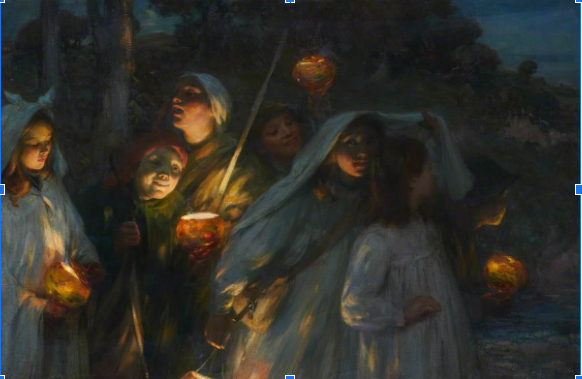
Cover Image: Hallowe’en by William Stewart MacGeorge
Credit: Royal Scottish Academy of Art and Architecture
Among the bracken, on the brae, Between her and the moon, The de’il, or else an outler quey, Gat up and gae a croon
- Halloween, Robert Burns
While Halloween is now one of the biggest and most commercial events of the year, its Celtic origins are often forgotten. Halloween as we know it now stems from two Celtic celebrations; Samhainn (S-ow-n) and Oidhche Shamhna (Uye-chyeh How-nuh).
Oidhche Shamhna was celebrated on the eve of Samhain - the 31st of October. This marked the end of harvest season and beginning of winter. As a result, celebrations often included bonfires as well as guisers (or Gìsears).
Guising is very similar to modern day ‘trick or treating’. While Guising has Celtic roots, the phrase ‘trick or treat’ originated in North American around the 1930s. The main difference between the two is that instead of threatening homeowners with pranks, guisers perform a turn (for example a song or a joke) to entice their audience to reward them with treats. Although, the giving or receiving of money wasn’t encouraged.
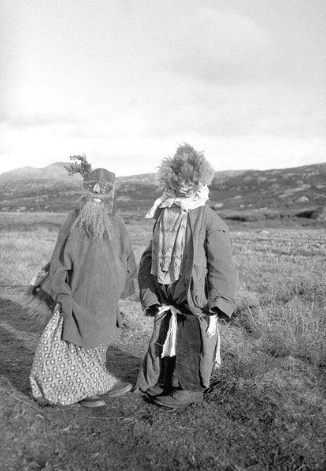
Halloween in South Usit, Margaret Fay Shaw
Credit: National Trust for Scotland
Each part of Scotland has its own variation on both guising, and Halloween ‘fashion’, but the Outer Hebridean traditions are particularly interesting. In South Uist, guisers would create costumes out of sheepskin, straw, or even skulls. One vivid account describes a young boy methodically removing a sheep’s skin so he could wear it as a mask.
The costumes are, admittedly, quite disturbing, but the purpose behind them is fairly logical. Locals believed that by dressing as the spirits that roamed the island, they would mistake you as one of their own and leave you be.
In Shetland, a similar tradition came in the form of Skelkers. Skelking would take place from mid-October to mid- January but is mainly associated with Oidhche Shamhna and Samhain. Much like guisers, Skelkers would go from house to house performing turns. Some would even perform a special dance. Their costumes are very distinctive in that they are made almost entirely from straw. Composed in two main parts, a hat and dress-structure, Skelkers would often hide their face from homeowners with a piece of sewn muslin. When visiting the houses on the island, skelkers would refuse to reveal their face unless their identity could be correctly guessed by the homeowner. To make matters even more confusing, they would often speak on an in-breath as to disguise their voice.
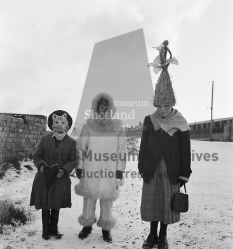
Image Credit: Shetland Museum and Archives
Samhainn (also known as Samhuinn or Sauin in Manx) was traditionally celebrated from the evening of the 31st of October, through to the 1st of November. It was one of the four ‘Quarter Days’ of the Celtic calendar, the other three being Imbolc, Beltane, and Lughnasadh. Given the agricultural context of the time, Quarter Days each marked important parts of the farming year. Samhain, like Oidhche Shamhnah, celebrated the end of harvest season. It also marked the divide between the light half of the year, and the dark half. On Samhain, the barrier between our world and the ‘Otherworld’ was thought to weaken. As a result, people could be visited by spirits of their relatives or even fairies and sprites. Samhain was also a time of agricultural symbolism. Farmers would bring in their cattle to slaughter for winter, and bonfires would be lit to cleanse and protect the local community.
Most of the photographic evidence we have of Samhain and Oidhche Shamhnah is thanks to Margaret Fay Shaw. A keen folklorist, Shaw lived on South Uist and documented the everyday lives of locals. Shaw’s photographs are remarkable and depict the strong sense of community shared by the residents.
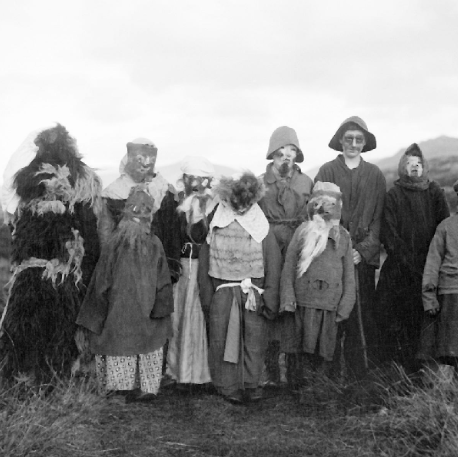
Image Credit: National Trust for Scotland/Canna House Photographic Collection
While many traditions, such as skelking, aren’t practiced anymore, lots of modern Scottish Halloween activities stem from these celebrations.
For example, many children still go guising on Halloween, still facing the expectation you’ll do a turn if you want a reward.
Even some more famous traditions like dookin’ (bobbing) for apples or playing party games have Celtic roots. In some traditions, after retrieving your apple you would peel a section and throw it over your shoulder. Whatever shape it made revealed the initial of your future spouse. When I was growing up, a game that was always a people pleaser was trying to eat a doughnut (traditionally a treacle scone) hung off a string without using your hands - which is just as crazy as it sounds.
While modern Halloween is very different from its Celtic ancestors, the importance of it in the Scottish calendar has remained unchanged.
Happy Halloween!
Oidche Shamhna shona dhut! (Uye-chyeh How-nuh haw-nuh yoot)