
Vampires Suck! Costume Design in Season 1 of AMC’s ‘Interview with a Vampire’
By Kitty Volino
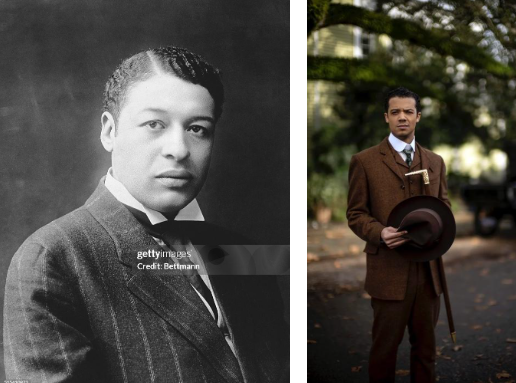
Image Credits: Vaudeville actor Bert Williams, Getty Images // Alfonso Bresciani/AMC
AMC’s award winning “Interview with the Vampire” follows the life of the vampire Louis, as told by him to journalist Daniel Molloy. Bases on Anne Rice’s book of the same name, Louis’ story begins in 1910s New Orleans. Throughout the series, we watch as Louis is pursued and turned by the vampire Lestat, and the creation of their ‘daughter’ Claudia.
In the first of many flashbacks, we see Louis’ mortal life as a wealthy businessman in a red-light neighbourhood known as ‘Storyville’. When business begins to boom towards the end of the decade, Louis starts to wear more vibrant colours. Costume designer Carol Cutshall notes being inspired by Black Vaudeville when designing Louis’ nightlife looks - specifically, what actors were wearing when they were off the stage. This provides Louis with almost an air of celebrity, as this is a scene he would have likely been familiar with.
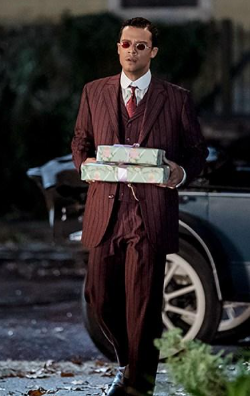
Image Credit: Alfonso Bresciani/AMC
However, Louis’ outfits also provide an insight into the social climate of the time. As a black business owner in the American south, his business and identity are constantly under threat. While Louis may be in the same social circles as them, by no means is he viewed as their equal. His constant high standard of clothing reflects his need to not only conform but go above what would be expected of him. This isn’t just a question of fashion, but of survival.
After being turned into a vampire by Lestat, Louis’ feelings of inadequacy are heightened by the need to hide his true nature from his family. Returning to his family home for his nieces’ birthdays, Louis arrives in a red pinstripe suit, with matching tie and tinted sunglasses. Cutshall uses the motif of stripes throughout the series to reflect a character’s feelings of entrapment and discontent. Here, Louis puts on the front of both the successful businessman, and mortal. Stripes become more prominent in Louis wardrobe from this point, as tensions begin to appear in Louis and Lestat’s relationship. Louis feels, as Cutshall puts it, like, “an animal caged by his affection for his creator, lover and abuser”. Similarly, in the modern day while he maintains his high standard of clothing, Louis dresses entirely in black, reflecting both his depression, and feelings of hopelessness
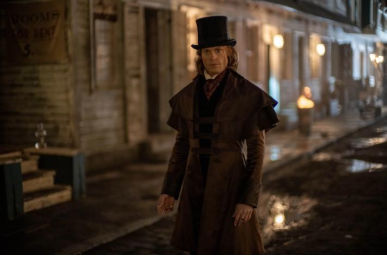
Image Credit: Alfonso Bresciani/AMC
Unlike Louis, Lestat’s clothes immediately make him stand out. When he first appears, Lestat is wearing a top hat, cravat, and ulster coat – all staples of 19th century men’s fashion. Notably, his hair is almost shoulder length – something very rare for men during this period. Instantly, the audience recognise he isn’t from this time.
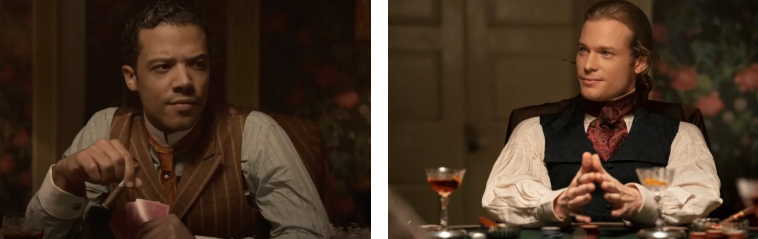
Image Credits: Metacritic/AMC, Alfonso Bresciani/AMC
The contrast between the pair can be seen during their poker game in episode one. Louis wears a fashionable tailored blue shirt and tie, underneath a brown wool waistcoat – notably, both fabrics are striped. Both his collar and cuffs are detachable and are secured in place by collar pins/cufflinks respectively. In contrast, Lestat wears a cravat and dropped sleeve shirt – two staples of 18th century men’s fashion.
As Lestat begins to spend more time with Louis, he quickly adapts to the contemporary fashion while still maintaining his own style. Cutshall explains designing Lestat’s outfits to fit him almost like corsetry. Fashion from his lifetime was far more restrictive, so while he is wearing modern outfits, his silhouette reflects those in the 18th century.
Cutshall notes a major source of inspiration for her designs was artist J.C.Leyendecker. A predecessor of Norman Rockwell, Leyendecker was a freelance artist best known for his sleek and elegant depictions of fashionable men and women as cover paintings. Famously, his, “Arrow Collar Man” was so well-received it soon became the reference for the male ideal (much like the Gibson Girl). However, what was less well known at the time was Leyendecker’s frequent model Charles A. Beach was also his life partner.
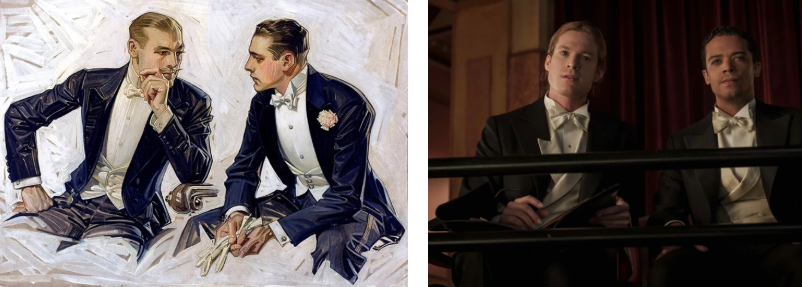
Image Credits: Alamy // Alfonso Bresciani/AMC
Homages are made across the series to Leyendecker’s work, and Cutshall explains that in many ways first two episodes are "a love letter to Leyendecker". This is particularly noticeable in Episode 2, “After the Phantoms of Your Former Self”, when Louis and Lestat attend the opera “Don Pasquale”. In an intimate scene, the two sit in Lestat’s private box as the overture begins. The two discuss the nature of vampirism, and Lestat reveals his true fear is loneliness and isolation, something overcome when he is with Louis. The two are a mirror to Leyendecker’s, “The Donchester - Cluett Dress Shirt”.
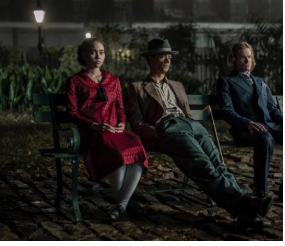
Image Credit: Alfonso Bresciani/AMC
Claudia is a prime example of the changing women’s wear in the 20th century. When she is first introduced, she wears very feminine, childish outfits. For her ‘birthday’ she wears a pink lace gown and gold tiara, while in other scenes she wears a girl’s sailor suit dress – an outfit synonymous with 1920s children’s fashion.
It's clear Louis is styling Claudia at this point, as she reflects his style of tailored elegance, and fashionable colouring. Yet this highlights her lack of agency – she does not choose the outfits she wears. As Claudia’s mind begins to mature, she begins resenting her immortal parents – particularly Lestat. As she becomes older, warm tones begin to feature more and more in her wardrobe. This conveys her simmering feelings of anger, and contrasts the cool toned palette of Louis and Lestat.
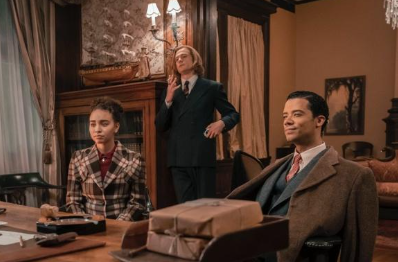
Image Credit: Alfonso Bresciani/AMC
Women’s fashion became less and less restrictive from the 1920s, as trousers gradually became a staple in women’s wardrobes. By the 1940s, Claudia is wearing fitted blazers with shoulder pads, in a more business wear look. It also becomes clearer she is choosing her own clothes, not Louis. She is slowly gaining more independence and authority, and her changing wardrobe reflects this.
Ultimately, Cutshall’s costume design provides a masterclass in storytelling through costume. Through subtle changes, she depicts different time periods, as well as character’s inner conflict and emotional state.